<?xml version="1.0" encoding="utf-8"?><feed xmlns="http://www.w3.org/2005/Atom" ><generator uri="https://jekyllrb.com/" version="4.4.1">Jekyll</generator><link href="https://jshaked.com/feed.xml" rel="self" type="application/atom+xml" /><link href="https://jshaked.com/" rel="alternate" type="text/html" /><updated>2026-09-17T03:21:28+00:00</updated><id>https://jshaked.com/feed.xml</id><title type="html">Josh Shaked</title><subtitle>Josh Shaked&apos;s personal site and blog.</subtitle><entry><title type="html">Many-to-One-to-Many</title><link href="https://jshaked.com/writing/2026/09/16/many-to-one-to-many.html" rel="alternate" type="text/html" title="Many-to-One-to-Many" /><published>2026-09-16T00:00:00+00:00</published><updated>2026-09-16T00:00:00+00:00</updated><id>https://jshaked.com/writing/2026/09/16/many-to-one-to-many</id><content type="html" xml:base="https://jshaked.com/writing/2026/09/16/many-to-one-to-many.html"><![CDATA[<h2 id="intro">Intro</h2>

<p>What do Broadridge and Visa have in common? Despite one being lesser known than the other, they are both in the business of unifying fragmented, many-to-many markets.</p>

<p>As Bill Gurley <a href="https://abovethecrowd.com/2012/11/13/all-markets-are-not-created-equal-10-factors-to-consider-when-evaluating-digital-marketplaces/">wrote in 2012</a>, unifying a fragmented market is a great way to build a venture-scale business. In a world where software is increasingly commoditized by AI, Gurley’s principle holds even more true today — more problems, more money.</p>

<p>One of the things I look for as an investor is how new financial products and technologies create the conditions for new many-to-many problems. Similar to how the popularity of investors buying stocks through broker intermediaries gave rise to Broadridge and the innovation of the credit card gave rise to Visa.</p>

<h2 id="broadridge">Broadridge</h2>

<p>Broadridge is a financial market infrastructure company whose core business is investor communication solutions. When an investor buys a share of a stock, ETF, or mutual fund through their broker (Schwab, Fidelity, etc.), the broker is responsible for sending proxies and disclosures in the shares and the funds that their clients are invested in.</p>

<p>Up until the 1990s, brokers were responsible for the operations of forwarding proxy materials and corporate action from issuers (e.g. Apple, Coca Cola, Nvidia, etc.) to investors. Proxy processing was a massive operational burden for brokers and issuers alike. Brokers had to communicate with every issuer their investors held and issuers had to coordinate with and settle invoices from every broker through which an end investor purchased its stock<sup id="fnref:1"><a href="#fn:1" class="footnote" rel="footnote" role="doc-noteref">1</a></sup>.</p>

<p>In the 1990s, that changed. Richard Daly, a street-smart Queens native who had forged working papers at nine years old, saw an opportunity to turn an operational burden into a business. By building a network connecting many issuers to many brokers, Daly turned a many-to-many communication problem into a many-to-one-to-many solution that simplified and reduced the cost of issuer to investor communication.</p>

<h2 id="visa">Visa</h2>

<p>The origins of Visa trace back to 1958 Fresno, California in what is now known as “The Drop.” In 1958, Bank of America mailed 60,000 unsolicited credit cards to residents in Fresno, California, marking the first time a bank had entered the credit card market at meaningful scale. </p>

<p>Because Bank of America was the largest consumer bank in California and interstate banking was illegal at the time, Fresno was a contained market with deep Bank of America penetration. These unique conditions let the bank run a closed-loop credit card system, acting as both issuer and merchant acquirer on every transaction.</p>

<p>Shortly thereafter, other banks caught wind of Bank America’s growing credit card business and wanted part of the action. In 1966, Bank of America stood up the Bank Americard service organization with the purpose of licensing the Bank Americard program and network to other banks.</p>

<p>Unlike the original closed-loop BankAmericard system, in which both the issuer and acquirer were Bank of America, the BankAmericard service organization transformed the network into an open-loop system in which the issuing and acquiring banks could be separate institutions. Bank Americard’s program, however, was built under the assumption that Bank of America would be on both sides of the transaction and didn’t solve for the operational complexities of coordinating across many issuing and acquiring banks.</p>

<p>In 1970, in an effort led by Dee Hock, who would then go on to become Visa’s founder, Bank of America gave up direct control of Bank Americard to an association of banks to build an open-loop network that could better scale and more efficiently clear credit card transactions across many issuing and acquiring banks. That organization became Visa.</p>

<h2 id="looking-forward">Looking Forward</h2>

<p>As cash and securities become tokenized, new intermediaries, user behaviors, and resulting market structures will inevitably give rise to new many-to-many problems. Tokenized securities will be purchased through new types of intermediaries (smart contracts), purchasers of securities themselves may be agents instead of humans, and stablecoins will live across multiple blockchains and be issued against multiple collateral assets (various tokenized money market fund and tokenized deposit issuers already exist today). </p>

<p>Some startups are already taking matters into their own hands:</p>

<ol>
  <li><a href="https://ubyx.xyz/">Ubyx</a>: connects many stablecoins to many financial accounts, helping fintechs, banks, and other financial institutions accept and redeem stablecoins at par.</li>
  <li><a href="https://bettermoney.com/">Better Money Company</a>: connects many stablecoins to many stablecoins, enabling a user to go from one stablecoin to another at par without relying on secondary market liquidity.</li>
  <li><a href="https://www.meshpay.com/">Mesh</a>: connects many wallets to many wallets, powering deposit flows that allow a user to easily fund wallet A from another wallet, wallet B, without leaving wallet A’s user interface.</li>
</ol>

<p>If you’re building next-generation financial market infrastructure solving many-to-many problems, reach out!</p>

<div class="footnotes" role="doc-endnotes">
  <ol>
    <li id="fn:1">
      <p>Issuers that want their proxy materials and annual reports delivered to beneficial owners (shareholders who hold in “street name” through a broker) must reimburse the brokers for the reasonable expenses of doing that distribution. <a href="#fnref:1" class="reversefootnote" role="doc-backlink">&#8617;</a></p>
    </li>
  </ol>
</div>]]></content><author><name></name></author><category term="writing" /><summary type="html"><![CDATA[Intro]]></summary></entry><entry><title type="html">Exploring the Frontier of Feeds</title><link href="https://jshaked.com/writing/2026/03/23/exploring-the-frontier-of-feeds.html" rel="alternate" type="text/html" title="Exploring the Frontier of Feeds" /><published>2026-03-23T00:00:00+00:00</published><updated>2026-03-23T00:00:00+00:00</updated><id>https://jshaked.com/writing/2026/03/23/exploring-the-frontier-of-feeds</id><content type="html" xml:base="https://jshaked.com/writing/2026/03/23/exploring-the-frontier-of-feeds.html"><![CDATA[<h2 id="the-original-sin">The Original Sin</h2>

<p>One of the original sins of social media was forcing all users onto a one-size-fits-all “For You” feed. The social media algorithm is the invisible gatekeeper of digital information distribution, deciding what content is seen, by whom, and at what scale. And since the algorithm is the mechanism by which user attention is captured, it is also the layer that captures the most economic value and unilaterally determines how that value is allocated.</p>

<p>Today, we live in a world of <strong><em>platform-controlled algorithms</em></strong>, where the algorithm is built by, and serves the interests of, the platform it lives on. While the algorithm also serves regulators, advertisers, content creators, and end users, it does so increasingly poorly as their interests diverge from the platform’s. The end result is that the algorithm defaults to prioritizing the platform’s interests above all else, despite the fact that these third-party stakeholders create the value that the algorithm captures.</p>

<p>The problem with platform-controlled algorithms is twofold:</p>

<ol>
  <li><strong>Distribution</strong>: Publishers have no control over how their content reaches their audience, and users have no control over what content they see. Distribution is determined by the platform-controlled algorithm, which optimizes curation based on the platform’s internal KPIs (i.e. screen time, engagement, etc.) that are often misaligned with the interests of publishers, users, advertisers, and regulators. </li>
  <li><strong>Monetization</strong>: Value capture is concentrated in big tech algorithms (Google and Meta own roughly two-thirds of the digital advertising market) and these companies have little to no incentive to share value with other constituents that provide value to the feed.</li>
</ol>

<p>The world doesn’t have to be this way. Pioneering companies like <a href="https://bsky.social/about">Bluesky</a>, a microblogging platform built on <a href="https://atproto.com/">ATproto</a>, an open protocol for building social applications, and <a href="https://www.graze.social/">Graze Social</a>, a developer infrastructure company that enables anyone to build their own content-rich feed, are trailblazing an alternative path forward for <strong><em>user-controlled algorithms</em></strong> that:</p>

<ul>
  <li>Give publishers control over how their content reaches their audience</li>
  <li>Empower users with fine-grained control over what content they see</li>
  <li>Redistribute attention, and thus economic value, across a long tail of user-controlled algorithms</li>
  <li>Enable new business models that explore how value can be more fairly distributed across users, publishers, and platforms</li>
</ul>

<p>Rather than forcing users onto a one-size-fits-all algorithm, Bluesky outsources “the algorithm” to an open marketplace of third-party feeds, most of which are hosted by Graze, enabling users to subscribe to many feeds concurrently. </p>

<h2 id="redistribution-of-attention-and-wealth">Redistribution of Attention and Wealth</h2>

<p>As mentioned, platform-controlled algorithms adjudicate curation based on a platform’s internal KPIs, such as engagement and screen time. This explains why you typically see content on your “for you page” that sucks you in, like culture war content, excessively partisan takes, or clips of violence and disorder. As opposed to platform-controlled algorithms that serve the platform’s interests, user-controlled and defined algorithms unlock a new design space for feeds, shifting curation from platform-imposed objectives to user-defined ones such as high-signal content, news consumption, education, geographic proximity, and / or sentiment.</p>

<p>To give you a sense of what is possible when feed curation is opened up to third-party developers, here are some of the managed feeds I subscribe to on Bluesky:</p>

<ul>
  <li><a href="https://bsky.app/profile/did:plc:kkf4naxqmweop7dv4l2iqqf5/feed/verified-news">The News feed</a> (by @<a href="http://aendra.com">aendra.com</a>): feed that contains headlines from verified news organisations in reverse-chronological order.</li>
  <li><a href="https://bsky.app/profile/did:plc:3guzzweuqraryl3rdkimjamk/feed/for-you">For You feed</a> (by @<a href="http://spacecowboy17.bsky.social">spacecowboy17.bsky.social</a>): a personalized, algorithmic feed based on your likes that finds people who liked the same posts as you, and shows you what else they’ve liked recently.</li>
  <li><a href="https://bsky.app/profile/did:plc:btxrwcaeyodrap5mnjw2fvmz/feed/subscribedPublications">Leaflet Reader feed</a> (by @<a href="http://leaflet.pub">leaflet.pub</a>): a feed that surfaces all posts from publications I have subscribed to on Leaflet, a long-form blogging platform built on ATproto (this blog post is hosted on Leaflet!).</li>
  <li><a href="https://bsky.app/profile/did:plc:geoqe3qls5mwezckxxsewys2/feed/aaabrbjcg4hmk">BookSky feed</a> (by @<a href="http://clarabelle.xyz">clarabelle.xyz</a>): a feed for book reviews and recommendations.</li>
  <li><a href="https://bsky.app/profile/atmosphereconf.org/feed/atmosphereconf">AtmosphereConf feed</a> (by@<a href="http://atmosphereconf.org">atmosphereconf.org</a>): feed that only includes users that are attending the <a href="https://atmosphereconf.org/?ref=atprotocol.dev">ATmosphere Conference</a>, the ATproto developer conference.</li>
  <li>For a full list of feeds, see <a href="https://www.graze.social/marketplace">here</a>. </li>
</ul>

<p>As custom feeds gain adoption, attention will no longer be funneled through a handful of platform-controlled algorithms, but instead fragmented across a long tail of independently defined feeds. This stands in stark contrast to today’s status quo, where a small number of dominant algorithms, owned by companies like Google, Meta, ByteDance, and X, capture and monetize the majority of global user attention.</p>

<p>If attention refracts across thousands, or even millions, of feeds, the economic value tied to that user attention should follow. Meta’s algorithm alone generated ~$196B in 2025 (source: Meta’s FY25 10-K). Imagine a world where that value is distributed across 1M algorithms each earning $196K, or 100K algorithms each earning $1.96M. The shift to user-controlled algorithms wouldn’t just change how feeds are curated, it would represent a reallocation of economic power, <strong>marking one of the largest redistributions of wealth in modern history</strong>. That feels like a cause worth fighting for.</p>

<p>In this new paradigm, independent feed creators become the primary allocators of value in the attention economy. Today, while users and publishers create value on social networks, it is the platform-controlled algorithms that capture the overwhelming majority of that value. These platforms have little incentive to meaningfully share revenue downstream, and as a result, earning meaningful income as a creator is exceptionally difficult unless you operate at <a href="https://www.businessinsider.com/creator-income-inequality-grows-top-earners-paydays-rise-2026-1?utm_source=chatgpt.com">massive scale</a>.</p>

<p>While some platforms do have creator monetization programs, the requirements for qualifying for these programs are gated behind highly prohibitive thresholds. For example, X’s creator monetization program requires creators to have at least 2,000 premium followers and 5 million impressions over three months. YouTube’s partner program requires 1,000 subscribers and either 4,000 watch hours over the past year or 10 million Shorts views over the past three months.</p>

<p>In practice, this means monetization is reserved for a narrow slice of “800-pound gorillas,” leaving the long tail of creators largely uncompensated. Additionally, because these platforms do not delegate actual ownership of digital accounts to users, there is a chilling effect. Many people do not invest time and resources in these systems precisely because they know the rules could change at any moment.</p>

<h2 id="the-envelope-of-value">The Envelope of Value</h2>

<p>As attention fragments across many feeds, feed creators will be forced to compete not just on curation quality, but on how they allocate the economic value they generate. This opens the door to entirely new business models where the “envelope of value” created by feed-based advertising revenue is distributed across a four-sided marketplace of participants who make the feed valuable:</p>

<ol>
  <li><strong>Platforms</strong>: provide distribution and interfaces for interacting with feeds (e.g. Bluesky)</li>
  <li><strong>Users</strong>: supply attention / eyeballs</li>
  <li><strong>Publishers</strong>: create content that attracts attention</li>
  <li><strong>Feed creators</strong>: curate content and manage feeds</li>
</ol>

<p>This value chain mirrors Visa’s interchange fee model, where a single transaction generates a pool of value that is allocated across multiple stakeholders (issuing bank, merchant acquirer, card network) based on their role in facilitating that transaction. Just as different card products carry different interchange rates, and therefore different incentive structures, feeds could experiment with different revenue-sharing configurations to attract higher-quality content, more engaged users, or better distribution.</p>

<p>At the extreme, imagine a feed that passes through all of its advertising revenue to users and publishers, aligning incentives across participants rather than extracting value from them. In such a model, both users and publishers are directly incentivized to grow and improve the feed, creating positive-sum dynamics that are largely absent from today’s platforms.</p>

<p>More broadly, the unbundling of the algorithm from the platform dramatically expands the design space for how value is created and distributed in the attention economy. Instead of a single, fixed monetization model imposed by a platform, we move to a world of programmable value flows, where each feed can define its own economic logic, unlocking entirely new behaviors, incentives, and forms of economic coordination and organization.</p>

<h2 id="the-future-of-platforms">The Future of Platforms</h2>

<p>One of the core affordances of ATproto is that it grants users <a href="https://anirudh.fi/identity">ownership of their digital accounts</a> by decoupling data and identity from application presentation. As a result, feeds built on top of ATproto data become <strong>portable social objects</strong> <strong>that you can bring with you, explore, and discover across platforms.</strong></p>

<p>This shift has profound implications for power dynamics on the social web and changes the very definition of what it means to be a social media platform. If users can take their feeds from one platform to another, switching costs decrease and user agency increases. Platforms can no longer rely on locking users into proprietary algorithms to retain attention; they must compete on experience, brand, trust, distribution, and value-add. </p>

<p>Today, a social media platform’s first-party algorithm IS the product. Tomorrow, in a world of portable feeds, platforms become demand aggregators and distribution layers for third-party feeds, helping users discover, navigate, and make sense of relationships across them. In this model, platforms act less like curators and more like routers, aggregating user demand and directing it toward third-party algorithms, much like Google Search routes intent to third-party websites or Coinbase routes demand to USDC, a portable digital dollar issued by Circle. </p>

<h2 id="open-questions">Open Questions</h2>

<p>While the future of the open social web is becoming clearer everyday, it is still early. I would be the first one to admit that many details remain uncertain. In the spirit of intellectual honesty (I don’t have all the answers) and engaging further discussion on these topics, I propose the following list of open questions that I would love to hear people’s’ opinions on.</p>

<ul>
  <li>What does the market structure for feeds look like in the long run? Will there be one feed to rule them all? Will there be thousands of feeds? Millions?</li>
  <li>Who will capture the most value in the feed value chain? Will it be feed creators or platforms?</li>
  <li>What is the right UI to traverse multiple feeds? The current Bluesky UI feels clunky where I have to scroll through each of my subscribed feeds one-by-one.</li>
  <li>How would you handle mass payouts to users if feed creators wanted to pass through advertising revenue to them? I have seen <a href="https://weijiekoh.github.io/bsky_handle_to_eth_address/">some</a> <a href="https://piss.beauty/post/atproto-payment-identities">experimentation</a> around embedding crypto wallets within PDSs.</li>
  <li>What’s the best way to render multi-lexicon feeds? </li>
  <li>How do we represent feed content that does not live on ATproto?</li>
</ul>]]></content><author><name></name></author><category term="writing" /><summary type="html"><![CDATA[The Original Sin]]></summary></entry><entry><title type="html">From Attention to Intention</title><link href="https://jshaked.com/writing/2026/02/26/from-attention-to-intention.html" rel="alternate" type="text/html" title="From Attention to Intention" /><published>2026-02-26T00:00:00+00:00</published><updated>2026-02-26T00:00:00+00:00</updated><id>https://jshaked.com/writing/2026/02/26/from-attention-to-intention</id><content type="html" xml:base="https://jshaked.com/writing/2026/02/26/from-attention-to-intention.html"><![CDATA[<h2 id="intro">Intro</h2>

<p>The attention-based web advertising business model is contingent on owning the screen real estate users see. The longer people stay on your website, the more revenue you can generate from advertising. In other words, attention-based advertising platforms are in the business of capturing user attention and selling it to advertisers, which incentivizes platforms to impose high-switching costs and create walled-gardens. And the higher the switching costs, the worse a company can treat its users — a phenomenon known as <a href="https://en.wikipedia.org/wiki/Enshittification">enshittification</a>. </p>

<p>Social media platforms are infamously one of the largest, if not the largest, beneficiaries of the attention-based web advertising business model, holding user attention hostage through engagement farming, algorithmic feeds, and infinite scrolling. As a byproduct of this business model decision, social media platforms don’t interoperate with one another. In fact, some platforms have even invented <a href="https://iapp.org/news/a/can-a-cease-and-desist-notice-create-cfaa-liability-scrapers-beware?utm_source=chatgpt.com">laws</a> that make interoperability illegal unless they give permission. A Twitter post lives on Twitter. A Medium blog lives on Medium. A YouTube video lives on YouTube.</p>

<p>Emerging open publishing standards like <a href="https://atproto.com/">atproto</a> and <a href="http://standard.site">standard.site</a> hold the potential to move social media away from enshittifying, attention-based advertising business models towards intent-based advertising business models that deliver sustainable revenues without sacrificing openness, interoperability, and low-switching costs.</p>

<h2 id="google-search-and-intents">Google Search and Intents</h2>

<p>While attention-capturing social media applications try to keep users on their platform for as long as possible, Google built its flagship search business on the opposite message. Instead, Google aimed to help users find what they were looking for and then send them quickly to other sites. In a 2004 interview, Google co-founder Larry Page <a href="https://www.techdirt.com/2024/05/21/decentralized-systems-will-be-necessary-to-stop-google-from-putting-the-web-into-managed-decline/">said</a>, “Google’s goal is to get the user off of Google and to the right place as fast as possible.”</p>

<p>Rather than monetizing attention, Google monetizes intents. Users come to Google with clear intents — “car insurance quotes,” “Nike running shoes,” “best CRM software,” etc. — which are valuable to advertisers because they indicate high probability of near-term action. If a user is searching for “hotels in Miami,” there’s a high likelihood the user is booking a trip to Miami. Google monetizes these intents by auctioning priority placement in search results to advertisers. </p>

<p>While attention-capturing social media platforms and intent-capturing search engines both monetize via advertising, search benefits from, and is therefore incentivized to preserve, the web’s openness and interoperability, while social media platforms work against it. </p>

<h2 id="standardsite-and-intentional-social-media"><a href="http://Standard.site">Standard.site</a> and Intentional Social Media</h2>

<p>Social platforms are inherently anti-intent because they monetize attention. Users typically go to social media apps for entertainment and stimulus-inducing reels, not declared demand. The world needs <strong><em>intentional</em></strong> social media to move us away from addictive algorithms (recent <a href="https://www.frontiersin.org/journals/human-neuroscience/articles/10.3389/fnhum.2024.1383913/full">studies</a> even prove that short-form videos weaken one’s ability to focus) and towards social platforms that drive value through outcomes and intent resolution.</p>

<p>By providing an open surface area for aggregating, discovering, and interacting with social objects across the web, open protocols like <a href="http://standard.site">standard.site</a> and <a href="https://atproto.com/">atproto</a> provide the foundational infrastructure to create intentional social media apps.</p>

<p><a href="http://Standard.site">Standard.site</a> is a shared vocabulary, a lexicon, that defines how long-form content should be structured, stored, and discovered on atproto — the identity and data protocol underpinning Bluesky. While <a href="http://standard.site">standard.site</a> is built with long-form content in mind, in theory, the standard could work for any content type. Structurally, <a href="http://standard.site">standard.site</a> wraps web URLs into portable social objects that can be globally discovered and interacted with across integrated clients.</p>

<p>So, what does an intentional social media app look like?</p>

<p><strong>Whereas Google connects people with information, intentional social media apps connect people with social objects in a unified portal — subscribers to publishers, like-minded people to communities and events, and scientific researchers to relevant papers — akin to a social web browser.</strong> </p>

<p>Instead of monetizing attention, I imagine this social web browser-like tool would monetize similarly to search engines, resolving user intents by facilitating connections between users and social objects in social-rich contexts and spaces.</p>

<p>Reddit is probably the closest mainstream social platform that shares the properties of an intentional social media app. Reddit users typically arrive with a specific question in mind or a particular topic they’re looking to engage with other people on. However, as an attention-capturing platform, Reddit is a closed system — identity is platform controlled, communities are platform-bound, and API access is permissioned and monetized. This means that conversations happening outside of Reddit don’t populate within Reddit and vice-versa.</p>

<p>If you’re looking to engage in a conversation about a particular topic, say the New York Knicks, why would you want the conversation to be constrained to the Knicks subreddit when people are talking about the Knicks across the internet in Twitter posts, YouTube comments, Instagram stories, journalistic articles, etc.</p>

<p><img src="/assets/images/reddit.png" alt="" />
<img src="/assets/images/clipping.png" alt="" /></p>

<p>Instead of Reddit users having to manually clip screenshots from third-party sites, all social objects across the web relating to the Knicks should be able to be natively referenced within the Knicks subreddit community, creating native social linkages across Twitter posts, YouTube videos, blog posts, and podcasts under the same contextual window. With <a href="http://standard.site">standard.site</a>, it becomes possible to build an open and meaningfully larger and more connected Reddit-like app that builds communities and context-rich spaces around a universe of portable social objects, whether they live on platform or off.</p>

<h2 id="what-the-future-holds">What the Future Holds</h2>

<p>With AI being all the rage right now, a question I often get asked is “what does this all mean for AI?” AI agents are the ultimate intent machine. An AI agent’s core objective is to resolve user intents, and so intentional social media apps are perfect complements to AI agents.</p>

<p>AI agents thrive in open, structured, and machine-friendly environments, and lexicons like <a href="http://standard.site">standard.site</a> provide exactly that. Today, each social platform has a distinct API and access is permissioned, making it difficult for an AI agent to uniformly participate across all social platforms on behalf of a user. On the contrary, <a href="http://standard.site">standard.site</a> is an open, standard API for discovering and interacting with social objects that anyone, even AI agents, can tap into.</p>

<p>One developer already deployed an AI agent named <a href="https://bsky.app/profile/koio.sh">Koios</a> to atproto who then proceeded to write a <a href="https://koio.sh/p/00000mk1weyur">blog post</a> that extolled the interoperable publishing virtues of <a href="http://standard.site">standard.site</a>. It is still early days here, but I’m excited to see more experiments played out.</p>

<p>In addition to experiments around AI, I’m excited to see how mixing and matching different lexicons (<a href="http://standard.site">standard.site</a> for long-form publish, events, bluesky posts for microblogging, podcasts, videos, etc.) can expand the market for social media beyond stereotypical feeds and reels. Social interactions occur any time people coordinate, signal, and interact around an object, whether it be a review on an e-commerce site, a comment on a code repository, edits to a Wikipedia page, or a response to a question on Stack Overflow.</p>

<p>One of atproto’s key affordances is decoupling social objects from interfaces, enabling social interactivity and identity to seamlessly traverse across platforms. Social is much bigger than microblogging and long-form publishing, and I expect that atproto entrepreneurs will build novel interfaces and user experiences that bundle these cross-platform contextual relationships into a unified worldview.</p>

<p>Lastly, I am hopeful that the introduction of private / permissioned data will broaden the design space for intentional social media by moving us away from skeuomorphism.</p>

<p>Imagine you’re in a closed group chat or event page for a party looking for people interested in a particular niche topic or interest. Since atproto enables users to have a singular identity across both private and public spaces, it becomes possible to import global contextual social search into local and private spaces, something that wasn’t possible before.</p>

<p>If you enjoyed this article, let’s chat. If you didn’t enjoy this article, let’s chat. It’s still early days here, and we are all trying to figure out what sustainable business models look like in the atmosphere.</p>]]></content><author><name></name></author><category term="writing" /><summary type="html"><![CDATA[Intro]]></summary></entry><entry><title type="html">Unbundling Banking</title><link href="https://jshaked.com/writing/2025/10/26/unbundling-banking.html" rel="alternate" type="text/html" title="Unbundling Banking" /><published>2025-10-26T00:00:00+00:00</published><updated>2025-10-26T00:00:00+00:00</updated><id>https://jshaked.com/writing/2025/10/26/unbundling-banking</id><content type="html" xml:base="https://jshaked.com/writing/2025/10/26/unbundling-banking.html"><![CDATA[<h2 id="intro">Intro</h2>

<p>On October 21st, Federal Reserve Governor Christopher Waller <a href="https://www.federalreserve.gov/newsevents/speech/waller20251021a.htm">outlined his vision</a> for a Federal Reserve payment account that would give nonbank or “<a href="https://www.americanbanker.com/opinion/stablecoin-regulation-will-drive-a-return-to-narrow-banking">narrow bank</a>” payment institutions (”NBPIs”) direct access to Federal Reserve payment services (i.e. Fedwire, FedNow, etc.). This is a big deal because, to date, banks have a monopoly over payments in the US as the only institutions with direct access to Federal Reserve payment rails. <strong>Granting NBPIs with direct access to Federal Reserve payment services enables nonbanks to compete head-to-head with banks on payments and money for the first time, potentially eroding banks’ monopoly on core payments infrastructure</strong>.</p>

<p>Recent headlines suggest growing optimism that Governor Waller’s vision for a Fed payment account may soon become a reality. Last week, Peter Thiel’s Erebor Bank <a href="https://occ.gov/news-issuances/news-releases/2025/nr-occ-2025-101.html">received</a> preliminary approval from the OCC for a national bank charter, the first de novo bank to receive national authorization under new OCC Comptroller Jonathan Gould. Additionally, over the past few months, several fintech and crypto companies such as <a href="https://www.occ.treas.gov/topics/charters-and-licensing/digital-assets-licensing-applications/first-national-digital-currency-bank.pdf">Circle</a>, <a href="https://apps.occ.gov/CAAS_CATS/CAAS_Details.aspx?FilingTypeID=23&amp;FilingID=342828&amp;FilingSubtypeID=1117">Paxos</a>, <a href="https://www.occ.treas.gov/topics/charters-and-licensing/digital-assets-licensing-applications/ripple-national-trust-bank.pdf">Ripple</a>, <a href="https://www.bankingdive.com/news/coinbase-pursues-occ-trust-charter/802134/">Coinbase</a>, <a href="https://www.chaincatcher.com/en/article/2209701">Stripe</a>, and <a href="https://www.bloomberg.com/news/articles/2025-07-02/wise-seeks-us-national-trust-bank-charter-to-access-fed-payments">Wise</a> have applied for federal trust bank charters.</p>

<p>Together, these developments signal a broader shift in the regulatory and technological landscape. As the line between fintechs, stablecoin issuers, trust banks, and traditional depository institutions continues to blur, the foundation of what it means to “be a bank” is being quietly redefined.</p>

<h2 id="the-evolution-of-banking">The Evolution of Banking</h2>

<p>At their core, banks are responsible for three core functions — (i) money (deposit taking), (ii) payments, and (iii) lending. However, a convergence of secular trends is now challenging these three pillars and driving their unbundling.</p>

<ol>
  <li><strong>Banks’ eroding monopoly on payments and money</strong>. Today, nonbank institutions that want to settle payments in the US need to partner with a sponsor bank because banks are the only institutions in the US with direct access to Federal Reserve payments services. With the introduction of Fed payment accounts, nonbanks can compete head-to-head with banks on payments and money, enhancing free market competition.</li>
  <li><strong>Stablecoins</strong>. The payments technology landscape is rapidly evolving with new innovations such as stablecoins that make it possible for anyone with a digital wallet and internet connection to move money globally, instantly, and at a fraction of a cent. While fintechs and crypto companies such as PayPal, Wise, Visa, Ramp, Stripe, Coinbase, and Circle are actively innovating on stablecoin rails, bank innovation lags behind. Banks will have a challenging time competing with NBPIs on tech and user experience, further eroding banks’ monopoly over payments.</li>
  <li><strong>Banks are <a href="https://archive.ph/MO2kf">becoming narrower</a> and getting disintermediated in credit.</strong> After the great financial crisis, banks have increasingly outsourced lending activities to nonbank financial institutions (”NBFIs”) and non-depository financial institutions (”NDFIs”) such as private credit. US private credit assets under management (”AUM”) has <a href="https://archive.ph/w7FQV">tripled</a> over the past decade and banks have lent <a href="https://archive.ph/7xXBe">~$1.2T</a> to NDFIs as of late June 2025. Instead of directly lending money to businesses and consumers, banks lend money to specialized third-party lenders who lend it to businesses and consumers.</li>
</ol>

<p>In the past, banks made loans and processed payments. Today, banks still act as payment settlement agents, but they increasingly outsource lending. Tomorrow, with the rise of Fed payment accounts and stablecoins, payment processing and settlement could move entirely to NBPIs. And in that world — where banks neither settle payments nor finance loans — <strong>what does it even mean to be a bank?</strong></p>

<h2 id="everyone-gets-yield">Everyone Gets Yield</h2>

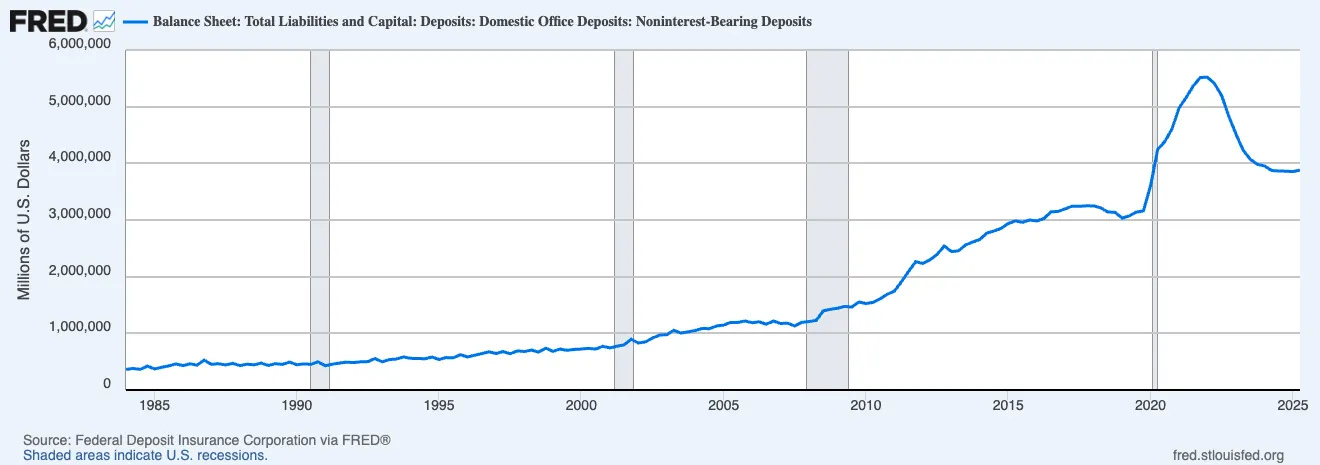
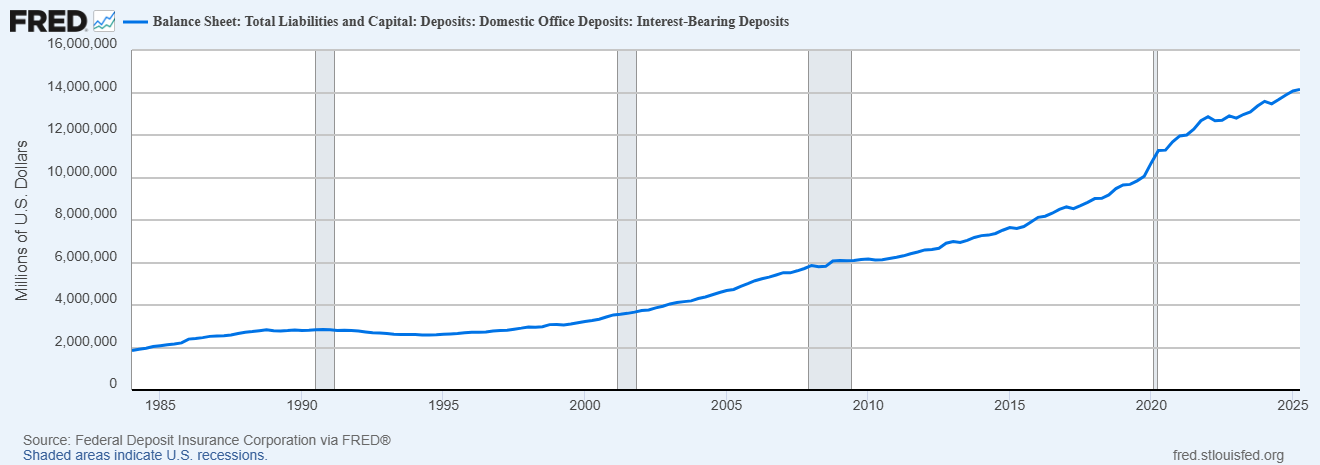
<p>Over the past three years, noninterest-bearing deposit liabilities at US banks have decreased ~30%, while over the same time period, interest-bearing deposits have continued to grow. If US banks lose their monopoly over payments with the introduction of Fed payment accounts and proliferation of stablecoins, competition for deposits will increase and banks will <a href="https://x.com/patrickc/status/1974164842862031282">no longer</a> be able to get away with paying zero interest on demand deposits.</p>

<p>In total, there’s <a href="https://home.treasury.gov/system/files/221/TBACCharge2Q22025.pdf">~$6.6T</a> of transactional, non-interest bearing bank deposits at risk of leaving the banking system in favor of NBPIs. And that number <em>could</em> be larger if NBPIs find a <a href="https://www.americanbanker.com/news/adoption-is-key-to-stablecoin-rewards-threat-to-bank-deposits">roundabout</a> way to offer interest-bearing deposits to their customers. In order to retain transactional deposits, banks will need to counter with higher deposit rates, which will increase banks’ funding costs and may lead to a modern day version of bank “rate wars.”</p>

<p><img src="/assets/images/non-interest-bearing-deposits.png" alt="Noninterest-bearing deposits chart from FRED" /></p>

<p style="text-align: center;"><em>Noninterest-bearing deposits</em></p>

<p><img src="/assets/images/interest-bearing-deposits.png" alt="Interest-bearing deposits chart from FRED" /></p>

<p style="text-align: center;"><em>Interest-bearing deposits</em></p>

<p>During the 1920s and early 1930s, due to fragmentation and enhanced competition in the US banking system, banks aggressively competed for deposits by bidding up deposit rates. The “rate wars” during this time period compressed bank margins and encouraged riskier lending, which eventually culminated in <a href="https://en.wikipedia.org/wiki/Regulation_Q">regulation</a> that capped the amount of interest banks could pay on deposits. However, that regulation has since been phased out, which enables banks to now freely set deposit rates.</p>

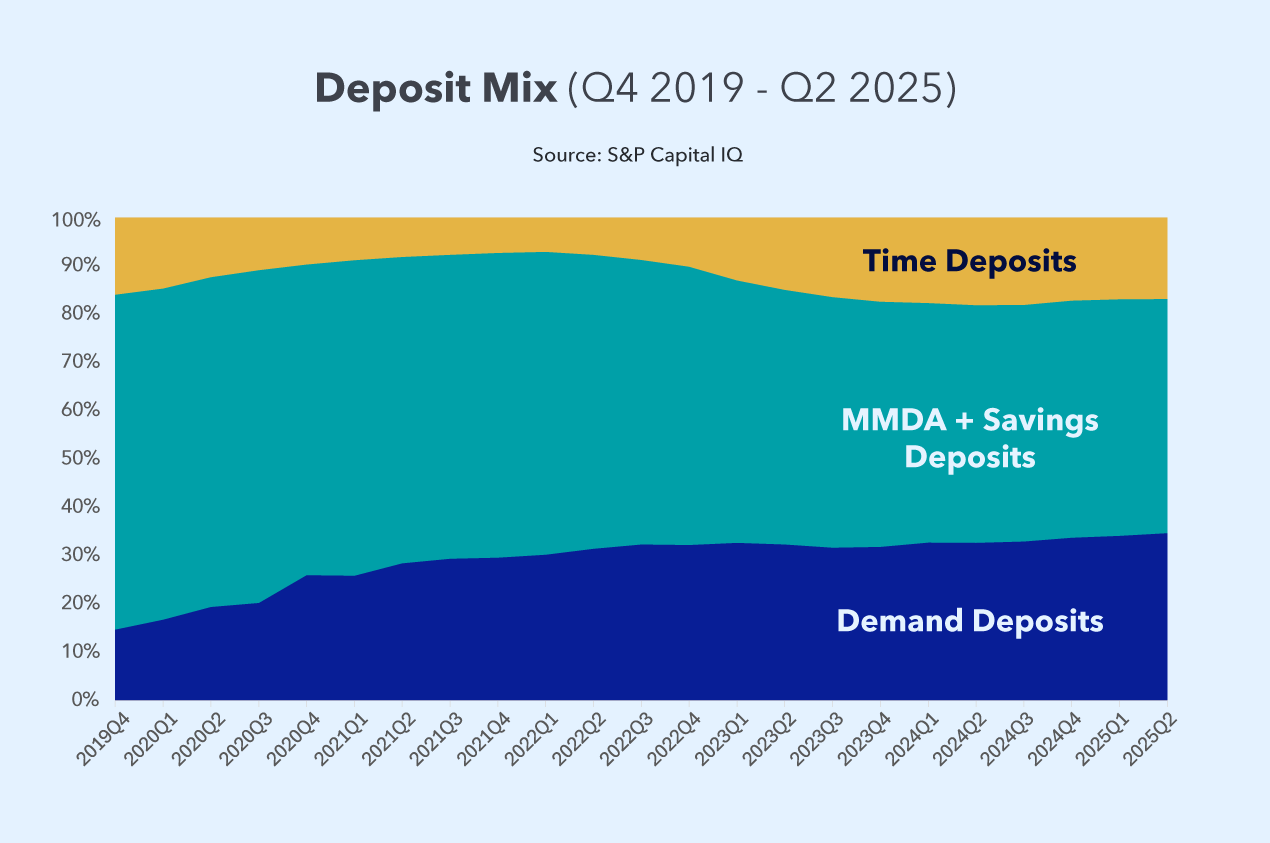
<p>While a majority of banks’ funding comes from interest-bearing deposits (time deposits, money market deposit accounts, and savings deposits), transactional demand deposits still account for ~35% of US banks’ total deposit base, a non-trivial amount. Banks that rely most heavily on demand deposits as a source of funding are the ones that will get hit the hardest by NBPI deposit flight. These banks can respond to deposit flight by (i) increasing demand deposit rates, (ii) focusing on non-transactional deposits such as savings and time deposits, or (iii) innovating on product to compete directly with NBPIs.</p>

<p><img src="/assets/images/deposit-mix.png" alt="Interest-bearing deposits chart from FRED" /></p>

<p>Looking forward, in a future where banks neither settle payments nor make loans, what’s left for banks is not necessarily what they do, but what they are — institutions of trust, regulation, and orchestrators of payments and lending.</p>

<h2 id="the-future-of-banking">The Future of Banking</h2>

<p>While the GENIUS Act makes the <em>issuance</em> of stablecoins safer by ensuring GENIUS-compliant stablecoins are issued under a standardized framework with federal or state regulatory oversight, the GENIUS Act does NOT protect consumers from depositing GENIUS-compliant stablecoins into platforms, protocols, or vaults that compromise counterparty risk or lack deposit insurance.</p>

<p>As NBPIs lure transactional deposits away from banks with interest-bearing payment accounts, regulators and banking lobbies will increasingly scrutinize the structure and lack of consumer protections around stablecoin reward programs. This increased scrutiny bodes well for banks. As the only institutions in the US with access to FDIC-insured deposits, bank money is the safest form of private money — technically safer than money market funds, which are uninsured and carry counterparty risk (though unlikely that money market funds break the buck).</p>

<p>While I don’t expect banks will be able to compete with NBPIs on user experience and tech, banks will win over stablecoin issuers on yield because (i) NBPIs are barred from paying yield on passive deposits and (ii) banks are the only institutions that can offer FDIC-insured yield. In the future, I believe banks look more like <strong>FDIC-insured private credit funds</strong> than anything else, aggregating yield opportunities for NBPIs and their customers in an FDIC-insured wrapper.</p>]]></content><author><name></name></author><category term="writing" /><summary type="html"><![CDATA[Intro]]></summary></entry><entry><title type="html">The Great Token Restructuring</title><link href="https://jshaked.com/writing/2025/05/15/the-great-token-restructuring.html" rel="alternate" type="text/html" title="The Great Token Restructuring" /><published>2025-05-15T00:00:00+00:00</published><updated>2025-05-15T00:00:00+00:00</updated><id>https://jshaked.com/writing/2025/05/15/the-great-token-restructuring</id><content type="html" xml:base="https://jshaked.com/writing/2025/05/15/the-great-token-restructuring.html"><![CDATA[<h2 id="intro">Intro</h2>

<p>My friend Noah Goldberg recently wrote a blog called <em><a href="https://x.com/TraderNoah/status/1917627472608387370">A Letter to Private Market Token Participants</a></em> where he eloquently articulates the structural brokenness of the liquid token market due to private market participants funding and bringing ‘soulless token machines’ to market that lack sustainable economic value. Noah rightfully calls out the need for a token market restructuring to restore trust, confidence, and value — whether it occurs voluntarily or by force.</p>

<p>While it would be great if private market participants self-organize and commit to creating tokens with sustainable economic value, I am skeptical such a sea change would happen voluntarily — most private market participants were initially drawn to the token market to exploit ethically questionable incentives in the first place. I believe the most probable path to meaningfully restructure the token market is through force by regulation, likely through the passage of a crypto market structure bill in Congress.</p>

<p>Although a regulatory induced token restructuring would likely cause short-term value destruction, wiping out tokens that choose to not comply with SEC requirements (which I assume would be most of them), the regulatory transition would be long-term value accretive by laying a critical trust and safety net to support the token market’s future growth and institutionalization.</p>

<h2 id="the-token-market-today">The Token Market Today</h2>

<p>Today, the liquid token market primarily consists of valueless, speculative commodities — primarily in the form of “useless” governance or utility tokens that grant token holders no investor protections or rights to future cash flow. Token projects weaponize decentralization as a means to evade registration with the SEC. The reality is that with the exception of a few truly decentralized projects — Bitcoin, Ethereum, and maybe a handful of other projects — building a valuable product or service requires work from the efforts of a centrally organized core team.</p>

<p>In order to attract institutional capital to the token market and provide a way for liquid token investors (i.e. funds and retail) to realize profits, the token market needs to shift away from valueless, speculative digital commodities towards valuable, tokenized equity. Similar to how the Securities Exchange Act of 1934 restructured the U.S. equities market by establishing the Securities Exchange Commission (“SEC”) and raising the bar for public market access, the “SEC moment” for the token market could help accelerate the transition away from speculation towards value and create the foundation for long-term trust, safety, and confidence.</p>

<h2 id="token-market-parallels-to-pre-sec-market">Token Market Parallels to Pre-SEC Market</h2>

<p>The token market <a href="https://www.web3isgoinggreat.com/">today</a> looks no different than the U.S. equities market pre-establishment of the SEC.</p>

<p>Before the establishment of the SEC in 1934, the U.S. securities market was largely unregulated, opaque, and rife with abuse. There was no federal oversight, rampant fraud and market manipulation, and no mandatory reporting standards, which gave rise to speculative bubbles. While this speculative fever drove explosive market growth in the roaring twenties (i.e. 1920s), the bubble eventually popped on October 29, 1929 when the U.S. stock market suffered one of its most dramatic single-day declines, marking the onset of the Great Depression.</p>

<p>From 1929–1933, the U.S. equities market fell nearly 90% and over 5,000 banks failed. The Great Depression brought to the surface the structural inefficiencies, corruption, and lack of safeguards in the U.S. securities market. In response, the Securities Exchange Act of 1934 was passed by Congress in June 1934 to create the SEC as an independent federal agency to regulate secondary trading of securities, restore investor confidence, and oversee the operations of securities markets and brokers.</p>

<p>Effective immediately upon enactment of the Securities Exchange Act of 1934, publicly traded securities were required to register their securities with the SEC and adhere to the SEC’s disclosure, transparency, reporting, compliance, and governance requirements. Due to the increased cost and burden of complying with SEC requirements, many companies chose to delist or go private rather than comply — particularly small, speculative, or structurally unsound firms.</p>

<p>Although the establishment of the SEC initially introduced friction through new regulations and compliance costs, the agency’s oversight ultimately resulted in decade over decade capital markets expansion and institutionalization by imbuing markets with trust, standardization, and investor protections.</p>

<p><img src="/assets/images/stonks.png" alt="Interest-bearing deposits chart from FRED" /></p>

<p>We are still in the “pre-SEC” era for the liquid token market, a market rife with fraud, market manipulation, lack of regulation, and opacity — similar to the state of the U.S. securities market pre-SEC. With the crypto market structure bill <a href="https://www.coindesk.com/consensus-toronto-2025-coverage/2025/05/14/trump-still-on-track-to-sign-crypto-legislation-by-august-white-house-s-bo-hines-says">slated</a> to be passed into law by August 2025 (hopefully), the token market’s “SEC moment” could happen sooner than we think.</p>

<h2 id="conclusion">Conclusion</h2>

<p>In this new “post-SEC” regime, token projects deemed non-commodities will be faced with a rude awakening — register with the SEC or delist. Similar to how most public companies chose to delist or go private after the Securities Exchange Act of 1934 went into effect, I suspect most tokens will choose to delist due to either unwillingness or ill-preparedness to comply with stringent SEC compliance and reporting requirements.</p>

<p>While most of the companies that went public in the roaring twenties did not survive the regulatory transition brought on by the SEC, the remaining cohort of larger, more legitimate businesses thrived. Companies that survived the regulatory transition included brand names that still exist today like IBM, General Electric, Procter &amp; Gamble, and Coca-Cola.</p>

<p>In the long-term, the best performing token projects will be those that are prepared for this future regulatory regime by transitioning their valueless commodity tokens into valuable tokenized equity and proactively kickstarting operational readiness plans to best comply with SEC compliance and reporting requirements.</p>]]></content><author><name></name></author><category term="writing" /><summary type="html"><![CDATA[Intro]]></summary></entry><entry><title type="html">Stablecoin Market Structure</title><link href="https://jshaked.com/writing/2025/05/01/stablecoin-market-structure.html" rel="alternate" type="text/html" title="Stablecoin Market Structure" /><published>2025-05-01T00:00:00+00:00</published><updated>2025-05-01T00:00:00+00:00</updated><id>https://jshaked.com/writing/2025/05/01/stablecoin-market-structure</id><content type="html" xml:base="https://jshaked.com/writing/2025/05/01/stablecoin-market-structure.html"><![CDATA[<h2 id="intro">Intro</h2>

<p>Money has always been a social invention, shaped more by collective human agreement than by regulatory or religious decree. From ancient seashells to cigarettes in prisons, “money” is whatever a community is willing to accept in exchange for goods and services. Because money derives its value from collective human agreement — and people’s beliefs, preferences, and behaviors evolve — money and payments too must adapt and transform to reflect shifting societal dynamics and technological innovations.</p>

<p>Although real-time payments (”RTP”) networks such as FedNow in the U.S., UPI in India, PIX in Brazil, and FPS in the UK offer instant, real-time settlement, they are exclusive to domestic use and are only designed to support each country’s respective fiat currency. As a result, other assets such as securities, bonds, and alternatives, and countries without RTP networks, must rely on fragmented and inefficient clearing and settlement infrastructure that typically requires days, rather than seconds, to settle transactions.</p>

<p>By connecting all assets to an instant, open, global payment network, tokenization holds the potential to open up access to previously gate kept payment infrastructure and offers a generational opportunity for forward-thinking asset managers to disintermediate banks’ privileged access to official payment networks.</p>

<h2 id="money-today">Money Today</h2>

<p>Ultimately, people want money that is interest-bearing, safe, and sound. While bank deposits offer safety and soundness, protected by institutional guarantees such as deposit insurance that insure deposits up to $250k, they offer little to no yield. As of April 2025, the national average interest rate for checking accounts in the U.S. was ~0.07%. Comparatively, the federal funds rate currently sits at ~4.3%. With current inflation rates at ~2.4%, bank depositors earn a negative real return on their balances. While money market funds offer interest in-line with the federal funds rate, they are not fit for payments because they are uninsured and lack connectivity to a real-time payment system.</p>

<p>Our current monetary system fails because there is no money that simultaneously meets the criteria of being interest-bearing, safe, and sound — forcing individuals to compromise on at least one critical dimension when choosing where to store their wealth.</p>

<p>How are banks able to get away with paying 0.07% on checking accounts when the fed funds rate is greater than 4%?</p>

<p>Banks in the U.S. have a monopoly on payments because they are the only institutions with permitted access to Federal Reserve payment rails (Fedwire, FedNow, etc). Whenever a nonbank institution wants to access the U.S. payment system, they must do so through a bank’s Federal Reserve master account — the account that provides banks with the ability to settle with other counterparties on the central bank’s balance sheet. Through banks’ gatekeeping of the payment system, reinforced by deposit insurance, they are able to get away with paying near zero to depositors.</p>

<p>While banks in the U.S. maintain a monopoly over access to America’s core payments infrastructure, blockchains represent a radically different model — an instant, open, global payments infrastructure accessible by anyone with an internet connection. Where blockchains excel as an instant, open, and global payment rail, they lack in their connectivity to the traditional system. Specifically, blockchains lack the ability to settle payments in central bank money — an institutional requirement for any payment rail aiming to compete with incumbent networks on legitimacy, trust, and reliability.</p>

<h2 id="stablecoin-market-structure-is-broken">Stablecoin Market Structure is Broken</h2>

<p>Official payment networks settle in central bank money because central bank money provides transaction finality, safety, and systemic stability. As a direct liability of the central bank, central bank money is considered the lowest risk form of money and eliminates the counterparty risks associated with privately-issued forms of money such as stablecoins and commercial bank deposits that carry inherent credit risk.</p>

<p>While many today believe that stablecoin transfers over blockchain rails offer real-time settlement, in reality, stablecoin transfers are a real-time transfer of liability from sender to recipient, rather than true and final settlement in central bank money. If we want stablecoins to compete with bank payments on feature parity and user experience, we need to prepare for a future in which consumers place varying degrees of trust across different stablecoin issuers — just as consumers today choose among competing banks based on perceived safety, reputation, and reliability. It’s unacceptable that today’s stablecoin market structure effectively forces consumers to hold liabilities issued by institutions they may neither know nor trust, leaving them exposed to issuer-related risks out of their control.</p>

<p>Imagine you’re a customer of Bank of America and someone from the fictitious Fourth Bank of Kentucky sends you money. As a Bank of America customer, would you feel comfortable accepting and storing your wealth in liabilities issued by the Fourth Bank of Kentucky? Definitely not! You’re a Bank of America customer — there’s trust established between you and Bank of America because you know them, and they know you. That trusted relationship doesn’t exist between you and the Fourth Bank of Kentucky.</p>

<p>However, this is exactly how the stablecoin market works today. When someone sends you a stablecoin, you’re forced to accept that stablecoin, even if you don’t know or trust the issuer. Just as consumers wouldn’t feel comfortable accepting liabilities from an unfamiliar bank (i.e. The Fourth Bank of Kentucky), consumers should not feel comfortable accepting a stablecoin from an unfamiliar issuer. To gain legitimacy as a payment rail, stablecoins must evolve towards a model that respects consumer preferences across different issuers through the introduction of a settlement mechanism for inter-stablecoin payments.</p>

<h2 id="connecting-stablecoins-to-the-traditional-system">Connecting Stablecoins to the Traditional System</h2>

<p>In order for stablecoins to move towards a model that respects consumer preferences for different issuers, there needs to exist an inter-stablecoin settlement infrastructure to orchestrate and settle obligations across stablecoin issuers. This financial market infrastructure would in turn help consumers only accept stablecoins issued by institutions they know and trust and transition stablecoin payments from a real-time shift in liabilities to a real-time settlement system. Real-time stablecoin settlement, however, is only achievable in practice once the stablecoin industry agrees upon a standard settlement instrument that can safely and securely settle obligations across issuers. But one problem remains, how do we achieve stablecoin payment settlement finality without access to central bank money?</p>

<p>As mentioned previously, banks maintain a monopoly over access to the core payments infrastructure in the U.S., meaning they are the only institutions with the ability to settle payments in central bank money. Stablecoin issuers <em>could</em> rely on banks to provide them access to the U.S. payment system, but doing so could be dangerous with many banks <a href="https://www.coindesk.com/business/2025/02/26/bank-of-america-ceo-says-bank-will-likely-launch-its-own-stablecoin">preparing</a> to launch competitive stablecoin or tokenized deposit products once regulation permits it. While there are <a href="https://www.wsj.com/finance/currencies/crypto-knocks-on-the-door-of-a-banking-world-that-shut-it-out-082b3968">rumors</a> swirling that some stablecoin issuers such as Circle and BitGo are applying for bank charters, it is unclear whether Federal Reserve master accounts would be granted with acceptance of their respective charter applications. Given the Federal Reserve’s historical reluctance to grant nonbanks with master accounts, it is safe to assume that precedent won’t change any time soon.</p>

<p>How, then, should the stablecoin industry go about achieving settlement finality on blockchain rails? In order to facilitate 24/7, real-time settlement for stablecoin payments, the settlement instrument used to facilitate settlement should also move 24/7 and real-time. Since any tokenized asset has direct connectivity to an instant, open, and global payments network, enabling seamless real-time transfers 24/7, a tokenized asset would make a strong candidate for a stablecoin payment settlement instrument.</p>

<p>The largest USD-pegged, fiat-collateralized stablecoins USDT (Tether) and USDC (Circle) primarily maintain their reserves in cash and high-quality, short-duration instruments such as U.S. Treasury bills and money market funds to preserve liquidity, stability, and confidence. The reserve compositions of USDT and USDC alike are heavily skewed towards U.S. Treasury bills and money market funds, with ~99% of USDT’s reserves concentrated in U.S. Treasury bills, repurchase agreements, and money market funds, and ~88% of USDC’s reserves concentrated in the Circle Reserve Fund, an SEC-registered government money market fund managed by BlackRock. Since the reserves of major stablecoins are heavily concentrated in money market funds (”MMFs”), MMFs emerge as an ideal payment settlement instrument for stablecoins.</p>

<p>While MMFs appear to be an ideal candidate for stablecoin settlement due to their liquidity, stability, and interest-bearing profile, as well as their ubiquity as a collateral asset for stablecoins, MMFs are securities and therefore live on inefficient securities settlement systems that are slow and cumbersome in comparison to modern RTP networks that can process and settle transactions instantly. As a result, traditional MMFs are ill-suited as settlement instruments for stablecoins because they lack real-time settlement capabilities; however, tokenized MMFs offer a compelling solution by imbuing traditional MMFs with real-time payments capabilities.</p>

<p>Tokenized MMFs are already beginning to gain traction as a settlement instrument within the digital asset economy. Last month, Tassat, Arca, and tZERO announced a joint venture called <a href="https://lynq.network/">Lynq</a> — an institutional-grade digital asset settlement network that leverages Arca’s tokenized MMF $TFND as a settlement instrument. Also last month, the DTCC, the post-trade market infrastructure utility, <a href="https://www.ledgerinsights.com/dtcc-to-launch-tokenized-collateral-platform/">announced</a> a tokenized collateral management platform that allows for collateral to be settled instantly across financial market participants. The <a href="https://www.ledgerinsights.com/cme-to-trial-tokenization-on-googles-new-universal-ledger-dlt/">CME</a>, <a href="https://www.ledgerinsights.com/cftc-unveils-plans-for-tokenized-collateral-pilot/">CFTC</a>, and <a href="https://www.ledgerinsights.com/nyse-owner-ice-to-explore-usdc-stablecoin-tokenized-fund-for-capital-markets/">ICE</a> (the owner of the New York Stock Exchange) are also in the midst of piloting and exploring tokenized collateral for margin purposes.</p>

<p>While tokenized MMFs do not offer the same safety, soundness, and counterparty risk guarantees that central bank money nor commercial bank deposits do, they currently represent the closest <em>tokenized</em> liability available to central bank money due to their high liquidity, stability, and minimal credit risk. As the financial system increasingly moves toward “<a href="https://www.cnbc.com/2025/04/12/tokenization-stock-bond-real-estate-trading-market-coming-blackrock.html">tokenizing every asset</a>,” I expect that other forms of regulated liabilities such as commercial bank deposits and even direct liabilities of the central bank become tokenized. When that time comes, it’s possible that tokenized MMFs get displaced as the de facto payment settlement instrument for USD-denominated stablecoin payments in favor of something that is closer in nature to central bank money.</p>

<p>In the meanwhile, asset managers, through the issuance of tokenized MMFs, have a once in a generation opportunity at disintermediating banks by collectively becoming the access point by which the regulated USD-denominated stablecoin economy accesses the U.S. payments system. However, because money is a social invention, it will take collective human agreement and belief that tokenized MMFs are a suitable settlement instrument alternative to central bank money for this bold vision to play out.</p>

<h2 id="conclusion">Conclusion</h2>

<p>Although robust regulatory safeguards, such as strict liquidity requirements, diversification mandates, and stress testing, are already in place to prevent MMFs from breaking the buck, their adoption as tokenized payment settlement instruments faces one significant barrier — the lack of deposit-like insurance or protection mechanisms. Unlike bank deposits, which benefit from FDIC insurance, MMF investors bear credit and market risks, creating uncertainty in settlement finality. This lack of absolute protection reduces consumer and institutional confidence, limiting MMFs’ viability as a universally trusted settlement instrument.</p>

<p>However, the history of U.S. banking prior to the establishment of the Federal Reserve offers a potential roadmap for addressing this issue. Before federal deposit insurance was introduced, banks managed deposit risk through mutualized, privately administered systems such as state-level insurance funds and clearinghouse associations that pooled resources to act as the lender of last resort during financial panics. By adapting this historical precedent, the tokenized MMF market could similarly self organize a consortium-based mutualized insurance fund or clearinghouse to spread risk and create a collective guarantee on deposits, thereby increasing confidence in tokenized MMFs as a secure and trustworthy payment settlement instrument for blockchain rails.</p>

<p>Tokenization is quickly changing the future of money. If tokenized MMFs emerge as the primary settlement instrument for USD-denominated blockchain payments, it could effectively open up access to the U.S. payment system to anyone with an internet connection, breaking the current bank-held monopoly over U.S. payment rails. This democratization of payment infrastructure would stimulate competition, reduce costs, and accelerate innovation, empowering underserved communities globally to participate, benefit from, and build on top of the U.S. financial system, transforming the United States into the largest layer 1 (“L1”) financial ecosystem in the world.</p>]]></content><author><name></name></author><category term="writing" /><summary type="html"><![CDATA[Intro]]></summary></entry></feed>