Unbundling Banking
Intro
On October 21st, Federal Reserve Governor Christopher Waller outlined his vision for a Federal Reserve payment account that would give nonbank or “narrow bank” payment institutions (”NBPIs”) direct access to Federal Reserve payment services (i.e. Fedwire, FedNow, etc.). This is a big deal because, to date, banks have a monopoly over payments in the US as the only institutions with direct access to Federal Reserve payment rails. Granting NBPIs with direct access to Federal Reserve payment services enables nonbanks to compete head-to-head with banks on payments and money for the first time, potentially eroding banks’ monopoly on core payments infrastructure.
Recent headlines suggest growing optimism that Governor Waller’s vision for a Fed payment account may soon become a reality. Last week, Peter Thiel’s Erebor Bank received preliminary approval from the OCC for a national bank charter, the first de novo bank to receive national authorization under new OCC Comptroller Jonathan Gould. Additionally, over the past few months, several fintech and crypto companies such as Circle, Paxos, Ripple, Coinbase, Stripe, and Wise have applied for federal trust bank charters.
Together, these developments signal a broader shift in the regulatory and technological landscape. As the line between fintechs, stablecoin issuers, trust banks, and traditional depository institutions continues to blur, the foundation of what it means to “be a bank” is being quietly redefined.
The Evolution of Banking
At their core, banks are responsible for three core functions — (i) money (deposit taking), (ii) payments, and (iii) lending. However, a convergence of secular trends is now challenging these three pillars and driving their unbundling.
- Banks’ eroding monopoly on payments and money. Today, nonbank institutions that want to settle payments in the US need to partner with a sponsor bank because banks are the only institutions in the US with direct access to Federal Reserve payments services. With the introduction of Fed payment accounts, nonbanks can compete head-to-head with banks on payments and money, enhancing free market competition.
- Stablecoins. The payments technology landscape is rapidly evolving with new innovations such as stablecoins that make it possible for anyone with a digital wallet and internet connection to move money globally, instantly, and at a fraction of a cent. While fintechs and crypto companies such as PayPal, Wise, Visa, Ramp, Stripe, Coinbase, and Circle are actively innovating on stablecoin rails, bank innovation lags behind. Banks will have a challenging time competing with NBPIs on tech and user experience, further eroding banks’ monopoly over payments.
- Banks are becoming narrower and getting disintermediated in credit. After the great financial crisis, banks have increasingly outsourced lending activities to nonbank financial institutions (”NBFIs”) and non-depository financial institutions (”NDFIs”) such as private credit. US private credit assets under management (”AUM”) has tripled over the past decade and banks have lent ~$1.2T to NDFIs as of late June 2025. Instead of directly lending money to businesses and consumers, banks lend money to specialized third-party lenders who lend it to businesses and consumers.
In the past, banks made loans and processed payments. Today, banks still act as payment settlement agents, but they increasingly outsource lending. Tomorrow, with the rise of Fed payment accounts and stablecoins, payment processing and settlement could move entirely to NBPIs. And in that world — where banks neither settle payments nor finance loans — what does it even mean to be a bank?
Everyone Gets Yield
Over the past three years, noninterest-bearing deposit liabilities at US banks have decreased ~30%, while over the same time period, interest-bearing deposits have continued to grow. If US banks lose their monopoly over payments with the introduction of Fed payment accounts and proliferation of stablecoins, competition for deposits will increase and banks will no longer be able to get away with paying zero interest on demand deposits.
In total, there’s ~$6.6T of transactional, non-interest bearing bank deposits at risk of leaving the banking system in favor of NBPIs. And that number could be larger if NBPIs find a roundabout way to offer interest-bearing deposits to their customers. In order to retain transactional deposits, banks will need to counter with higher deposit rates, which will increase banks’ funding costs and may lead to a modern day version of bank “rate wars.”
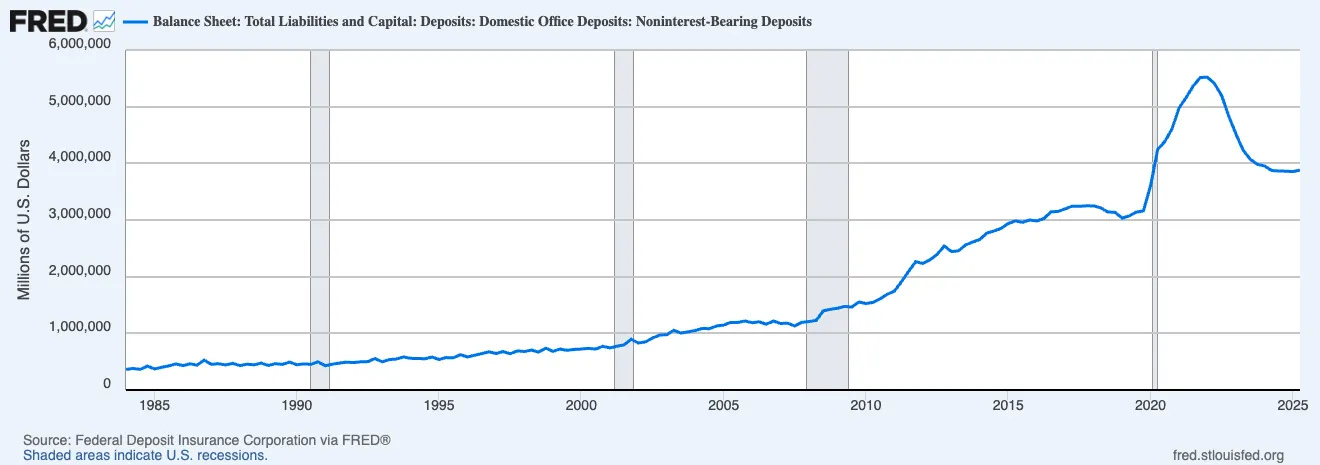
Noninterest-bearing deposits
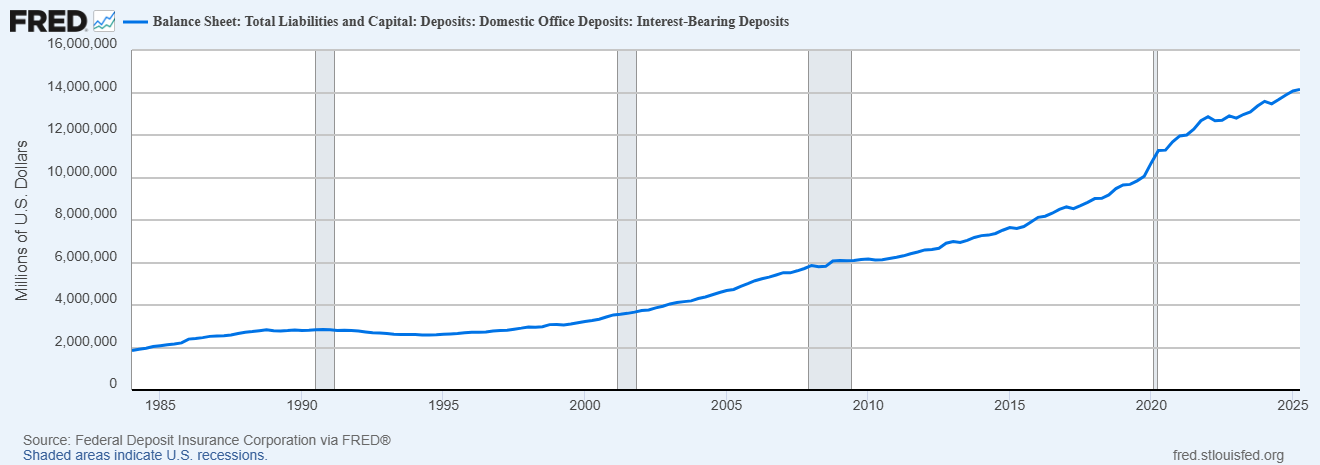
Interest-bearing deposits
During the 1920s and early 1930s, due to fragmentation and enhanced competition in the US banking system, banks aggressively competed for deposits by bidding up deposit rates. The “rate wars” during this time period compressed bank margins and encouraged riskier lending, which eventually culminated in regulation that capped the amount of interest banks could pay on deposits. However, that regulation has since been phased out, which enables banks to now freely set deposit rates.
While a majority of banks’ funding comes from interest-bearing deposits (time deposits, money market deposit accounts, and savings deposits), transactional demand deposits still account for ~35% of US banks’ total deposit base, a non-trivial amount. Banks that rely most heavily on demand deposits as a source of funding are the ones that will get hit the hardest by NBPI deposit flight. These banks can respond to deposit flight by (i) increasing demand deposit rates, (ii) focusing on non-transactional deposits such as savings and time deposits, or (iii) innovating on product to compete directly with NBPIs.
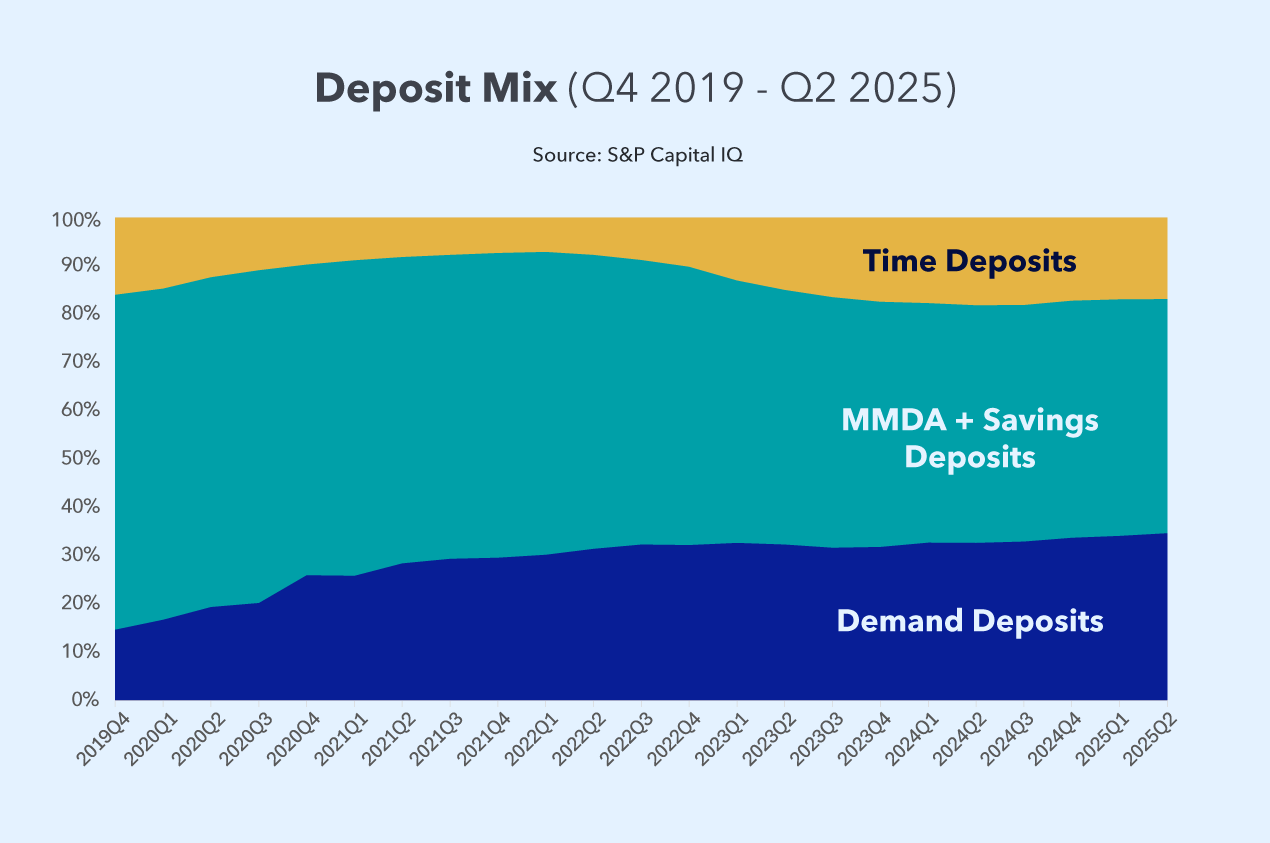
Looking forward, in a future where banks neither settle payments nor make loans, what’s left for banks is not necessarily what they do, but what they are — institutions of trust, regulation, and orchestrators of payments and lending.
The Future of Banking
While the GENIUS Act makes the issuance of stablecoins safer by ensuring GENIUS-compliant stablecoins are issued under a standardized framework with federal or state regulatory oversight, the GENIUS Act does NOT protect consumers from depositing GENIUS-compliant stablecoins into platforms, protocols, or vaults that compromise counterparty risk or lack deposit insurance.
As NBPIs lure transactional deposits away from banks with interest-bearing payment accounts, regulators and banking lobbies will increasingly scrutinize the structure and lack of consumer protections around stablecoin reward programs. This increased scrutiny bodes well for banks. As the only institutions in the US with access to FDIC-insured deposits, bank money is the safest form of private money — technically safer than money market funds, which are uninsured and carry counterparty risk (though unlikely that money market funds break the buck).
While I don’t expect banks will be able to compete with NBPIs on user experience and tech, banks will win over stablecoin issuers on yield because (i) NBPIs are barred from paying yield on passive deposits and (ii) banks are the only institutions that can offer FDIC-insured yield. In the future, I believe banks look more like FDIC-insured private credit funds than anything else, aggregating yield opportunities for NBPIs and their customers in an FDIC-insured wrapper.